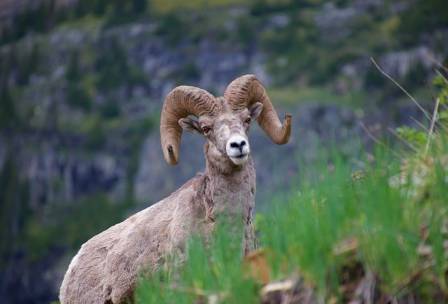
Distribution
The Sierra Nevada bighorn sheep is endemic to California's Sierra Nevada mountain range. Historically, their territory extended from Sonora Pass in the north to Olancha Peak in the south, reaching as far west as the Mineral King area of Sequoia National Park. Presently, they inhabit 12 of the 16 designated herd units outlined in the Sierra Nevada Bighorn Sheep Recovery Plan, plus two supplementary herds in the Cathedral Range and Bubbs Creek areas. The northernmost herds reside near Yosemite National Park's eastern boundary around Excelsior Peak. Other populations are scattered southward along the Owens Valley's western escarpment to the southeastern edges of Sequoia National Park near Mount Langley, extending south to Olancha Peak. This recovery zone spans two national parks (Yosemite, and Sequoia-Kings Canyon), four national forests (Inyo, Humboldt-Toiyabe, Sierra, and Sequoia), and Bureau of Land Management territories. Nearly the entire recovery area consists of federal land, predominantly within designated wilderness areas (John Muir, Ansel Adams, Hoover, and Golden Trout).
Living Environment
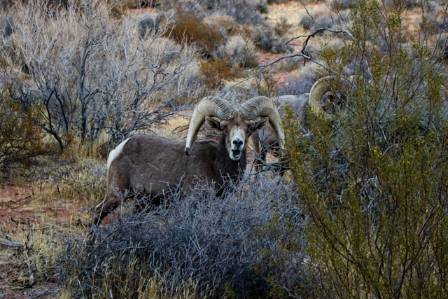
Characteristic Sierra bighorn habitat consists of rugged, rocky, and precipitous landscapes. This includes alpine meadows, plateau summits, and spring-fed hanging meadows embedded within escape terrain. Such topography provides anti-predator advantages by offering immediate access to protective rugged areas adjacent to foraging grounds.
Multiple herd units maintain separate seasonal ranges, with lower-elevation winter grounds providing better nutrient access and reduced snow cover during winter and early spring. Summer ranges typically occupy high elevations (3,000-4,300 m) with abundant alpine vegetation. Winter ranges generally occur at lower elevations (1,500-2,700 m), though some individuals overwinter in high alpine zones (3,400-3,700 m). The species prefers open landscapes where their exceptional vision can detect threats, avoiding densely forested areas and thick vegetation.
Seasonal Movements
Altitudinal migration enables Sierra bighorn to optimize nutritional intake by tracking seasonal plant growth from lower winter ranges (early growth) to higher summer pastures (later growth). While showing strong site fidelity by typically returning to the same seasonal ranges annually, individuals may alternate between high and low elevation wintering areas. Although most remain within established home ranges throughout their lives, some expansion into adjacent habitats occurs. Average annual home ranges span approximately 50 km² for females and 100 km² for males.
Diet and Nutrition
As ruminant herbivores, bighorn sheep consume grasses, forbs, and shrubs. They display selective feeding behavior, choosing the most nutrient-rich available vegetation. Emerging plant growth provides the highest nutritional value, though this varies by species, resulting in seasonal dietary shifts. During periods of surplus nutrition, animals accumulate fat reserves for lean-season maintenance and reproductive needs.
Life Cycle
The rutting period extends from mid-October through mid-December. Following a six-month gestation, ewes typically birth single lambs between mid-April and mid-June. Neonates become mobile within days and are usually weaned by five months of age.
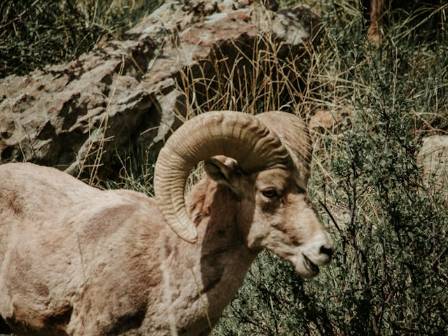
Before each breeding season, rams establish social hierarchy through dominance contests. These include visual threats, displacement from resting sites, kicking, butting, neck wrestling, and spectacular horn clashes that echo like gunshots across mountainsides. Largest-bodied males with biggest horns typically achieve dominance, granting them primary breeding access through polygynous mating systems.
Conservation Status
From historical populations numbering thousands, Sierra bighorn declined to merely 105 individuals by 1995. This catastrophic drop mirrors Native American population collapses, with diseases from domestic sheep herds introduced by California shepherds devastating wild populations. The subspecies gained federal endangered species protection on January 3, 2000 (following emergency listing April 20, 1999), with similar state reclassification from threatened to endangered in 1999.
Population numbers remain volatile. Prior to record snowfall during 2022-23, counts exceeded 500 animals, but severe winter conditions caused significant declines. Current conservation efforts by CDFW focus on stabilizing and recovering populations.
Protection Measures
Management follows the Sierra Nevada Bighorn Recovery Plan under ESA guidelines. The California Department of Fish and Wildlife leads conservation efforts with U.S. Fish and Wildlife Service, collaborating with National Park Service, BLM, U.S. Forest Service, and USDA Wildlife Services. Key recovery strategies include: (1) managing disease transmission from domestic sheep, (2) translocation projects to boost numbers and distribution, (3) predator control measures, and (4) genetic diversity monitoring.
Primary Challenges
Major recovery impediments include: disease from domestic sheep and goats, predation pressure, genetic erosion from inbreeding, and demographic vulnerabilities from small population size. These factors can create an extinction vortex where interconnected threats continuously reduce survival and reproduction, potentially causing irreversible decline without intervention.
Population Objectives
Downlisting to threatened status requires: (1) 305 mature females distributed across four recovery units, (2) occupation of 12 specified herd units, and (3) effective separation from domestic sheep and goats. Delisting further requires maintaining target numbers and distribution for seven consecutive years without management intervention. Currently, all 12 required herd units plus two additional units support bighorn populations.
Viewing Opportunities
Winter observations are best along Pine Creek Road west of Rovana, where Wheeler Ridge cliffs often hold visible herds. Summer viewing opportunities exist in Cottonwood Lakes Basin, Mount Langley area, and along the Tamarack Lakes trail from Rock Creek Lake. Their superb camouflage makes sightings challenging.